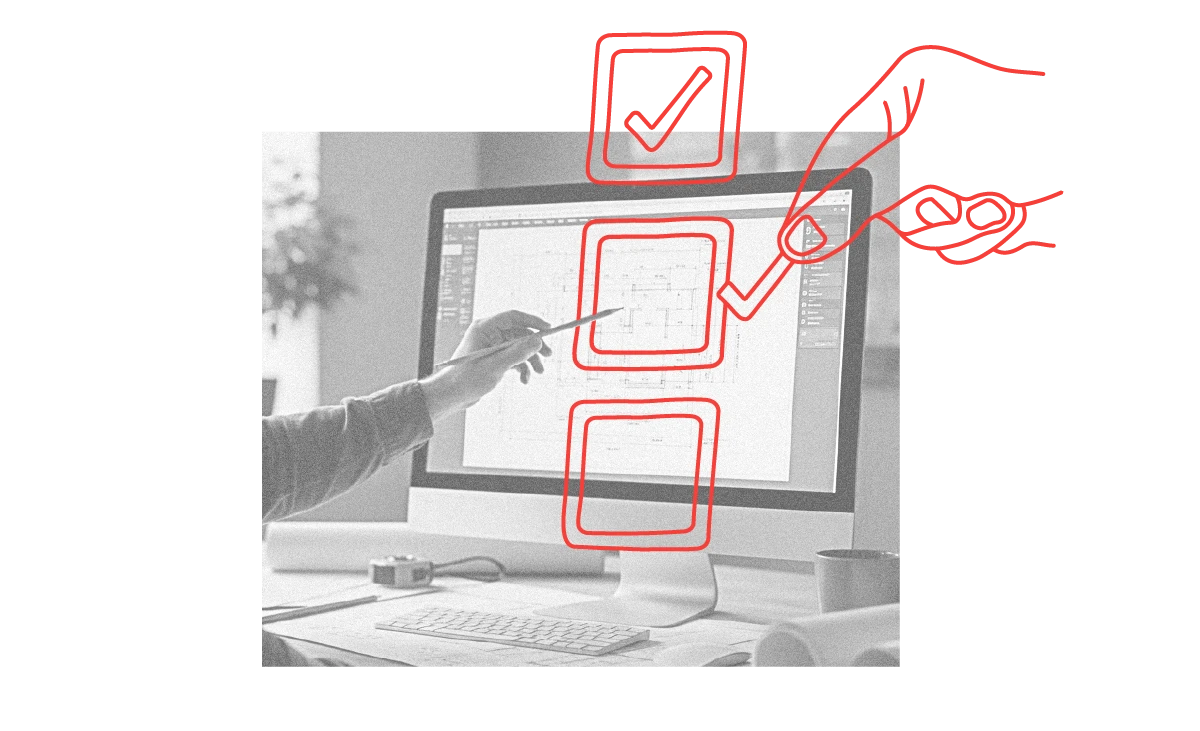
 Architects Don’t Buy. They Validate.
Most building product marketing is built around the wrong assumption.
The assumption is that architects “buy.”
They don’t.
They validate.
And if you misunderstand that distinction, you’ll measure the wrong things, build the wrong tools, and miss the real moment where specification decisions happen.
The Buying Myth in Building Materials
Traditional marketing language sounds like this:
- Generate more leads
- Increase conversions
- Optimize the funnel
- Improve click-through rates
That works in e-commerce.
It does not reflect how specification-driven industries work. Architects are rarely sitting at their desks thinking:
“I’d like to purchase a new building product today.”
They’re mid-project. They’re under deadline. They’re navigating code requirements, client preferences, engineering constraints, and budget realities. They are not shopping. They are mitigating risk.
What Validation Actually Looks Like
Validation is quiet. It happens in short windows of time. Often after hours.
It looks like:
- Downloading a BIM file
- Checking a fire rating
- Confirming span data
- Reviewing install details
- Looking for proof of testing
- Verifying compliance
- Seeing if a competitor feels “safer”
They are asking one core question:
“Can I trust this manufacturer on this project?”
That trust is built through documentation, clarity, accessibility, and reputation.
Validation is friction-sensitive. If it’s hard to find what they need, they don’t complain. They move on.
Why This Matters to Marketing Leaders
If architects validate instead of buy, then your KPIs need to reflect that reality.
Website traffic alone doesn’t tell you if validation is happening.
Download counts don’t tell you whether your product feels low-risk.
Marketing Qualified Lead (MQL) volume doesn’t tell you whether you’re influencing specification behavior.
When validation is weak, it shows up downstream as:
- Increased value engineering pressure
- Spec substitutions
- “We were listed but didn’t win”
- Sales reps fighting price conversations
If you’re arguing price at value engineering, the validation work upstream wasn’t strong enough.
The Validation Model
Instead of asking:
“How do we generate more leads?”
Ask:
“How do we make validation easier than choosing a competitor?”
That requires alignment across:
- Website Infrastructure
Technical documents accessible.
BIM files easy to find.
Product hierarchy intuitive. - Performance Proof
Testing clearly documented.
Compliance obvious.
Claims defensible. - Sales Tooling
Reps equipped to defend specification.
Clear install documentation.
Total lifecycle arguments ready. - Brand Credibility
Projects visible.
Industry presence established.
Consistency across touchpoints.
Validation is ecosystem-driven. Not campaign-driven.
The Cost of Getting This Wrong
When marketing focuses only on clicks and impressions, it creates activity without influence.
When validation is prioritized, you see:
- Higher spec retention
- Less substitution
- Stronger preference
- Reduced margin erosion
Architects don’t need more noise. They need clarity.
If you’re rethinking how your marketing supports specification — not just awareness — that’s where strategy starts.
And strategy always comes first.